Original
Made and sold by us. Any problem with it is ours to fix.
Situational Dilemma · Book 2
Ages 6–9₹499.00
Something happened. Now what? A seedling got pulled up by mistake. A thank-you went to the wrong person. A cushion got ripped, and your child did not do it. Twenty new real-life family situations, each drawn full-page for colouring, and each one starting just after something has already happened.
In every situation your child chooses between three realistic responses, stands in the Four Corners to think it through, answers two thinking questions and does one activity. What each choice led to stays hidden at the back until all twenty are decided.
20 situations · 60 choices · ages 6–9 · digital PDF, 91 A4 pages · ₹499. Book 1 is not needed — you can start here.
Description
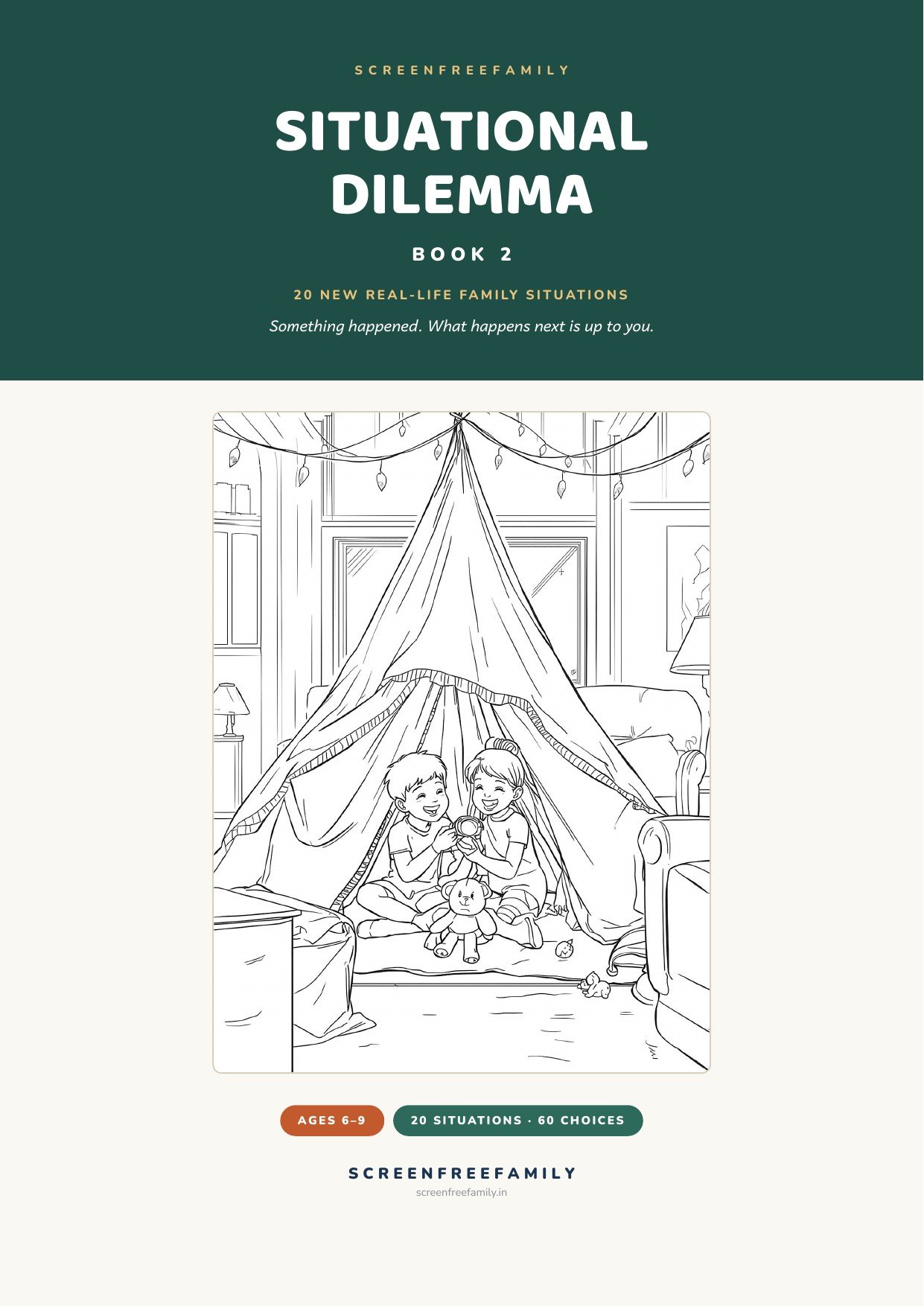
SITUATIONAL DILEMMA · BOOK 2
20 New Real-Life Family Situations for Ages 6–9
Something happened. What happens next is up to you.
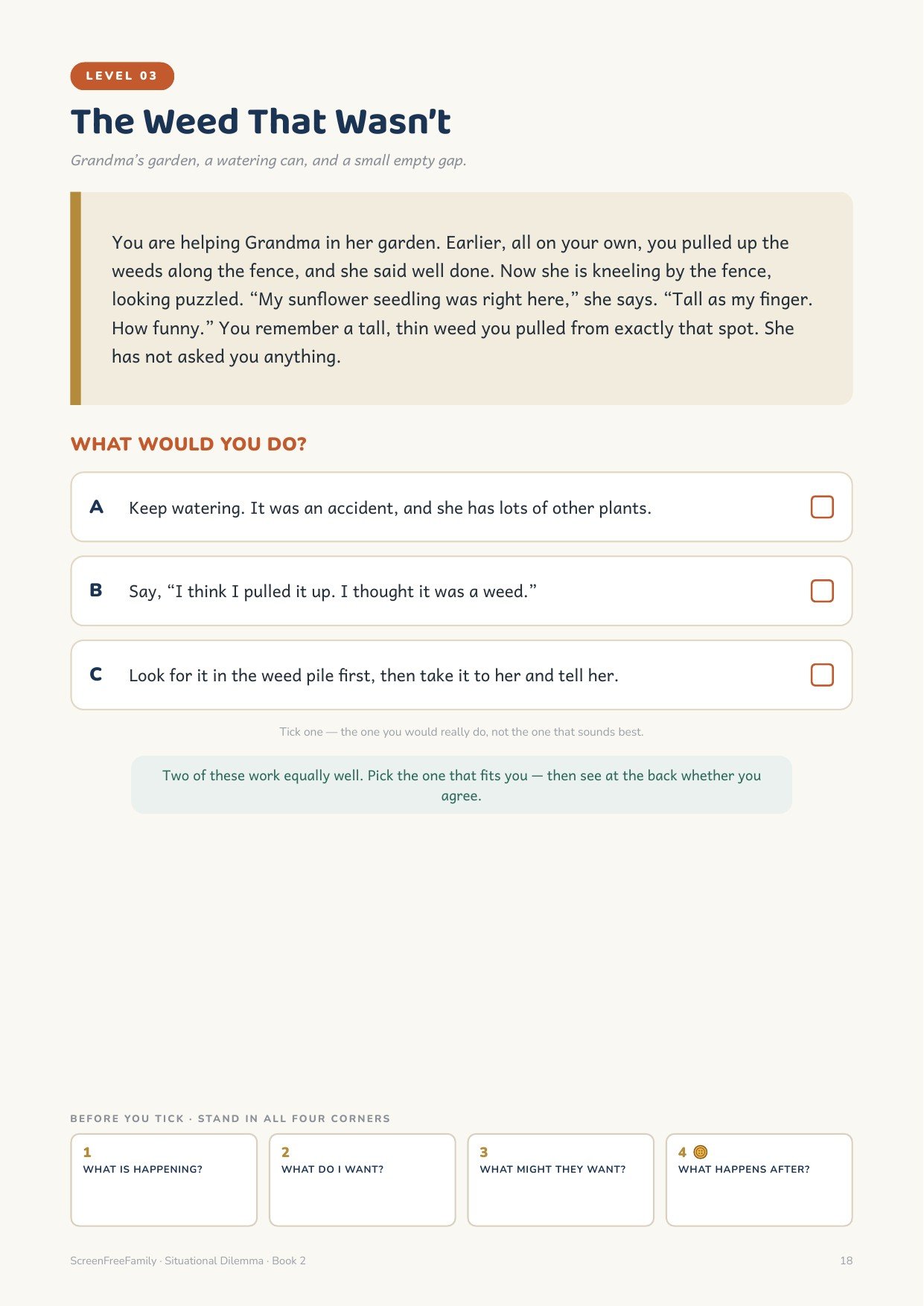
A sunflower seedling pulled up because it looked like a weed. A thank-you from Dad that really belonged to a big sister. A little brother asking to read the notebook that is only for you. A balloon that slipped away on the walk home — and a promise made at the door.
Nobody hands a child an instruction in moments like these. Situational Dilemma · Book 2 turns twenty of them into a book a child can colour, decide and talk about.
Something Happened. Now What?
Book 1 was about the tricky moment while it is going on. Book 2 is mostly about the moment after. Something has already happened — a mistake, an accident, a misunderstanding, a promise that suddenly got harder to keep — and now your child has to decide what to do about it.
Owning up. Keeping quiet. Putting it right. Keeping a promise. Keeping a surprise. Saying no kindly. Each is a real option, and choosing one means not choosing the others. That is what makes it a dilemma.
What is Situational Dilemma · Book 2?
A screen-free colouring, thinking and activity book for children aged about 6–9. Every situation is an ordinary family moment — a grandparent’s garden, a blanket fort, a queue for the park train, a thunderstorm at night — with three believable things a child might really do. None of them is the silly one.
Your child ticks the one they would honestly do, not the one that sounds best. The book is explicit that nobody is marking them.
What’s inside
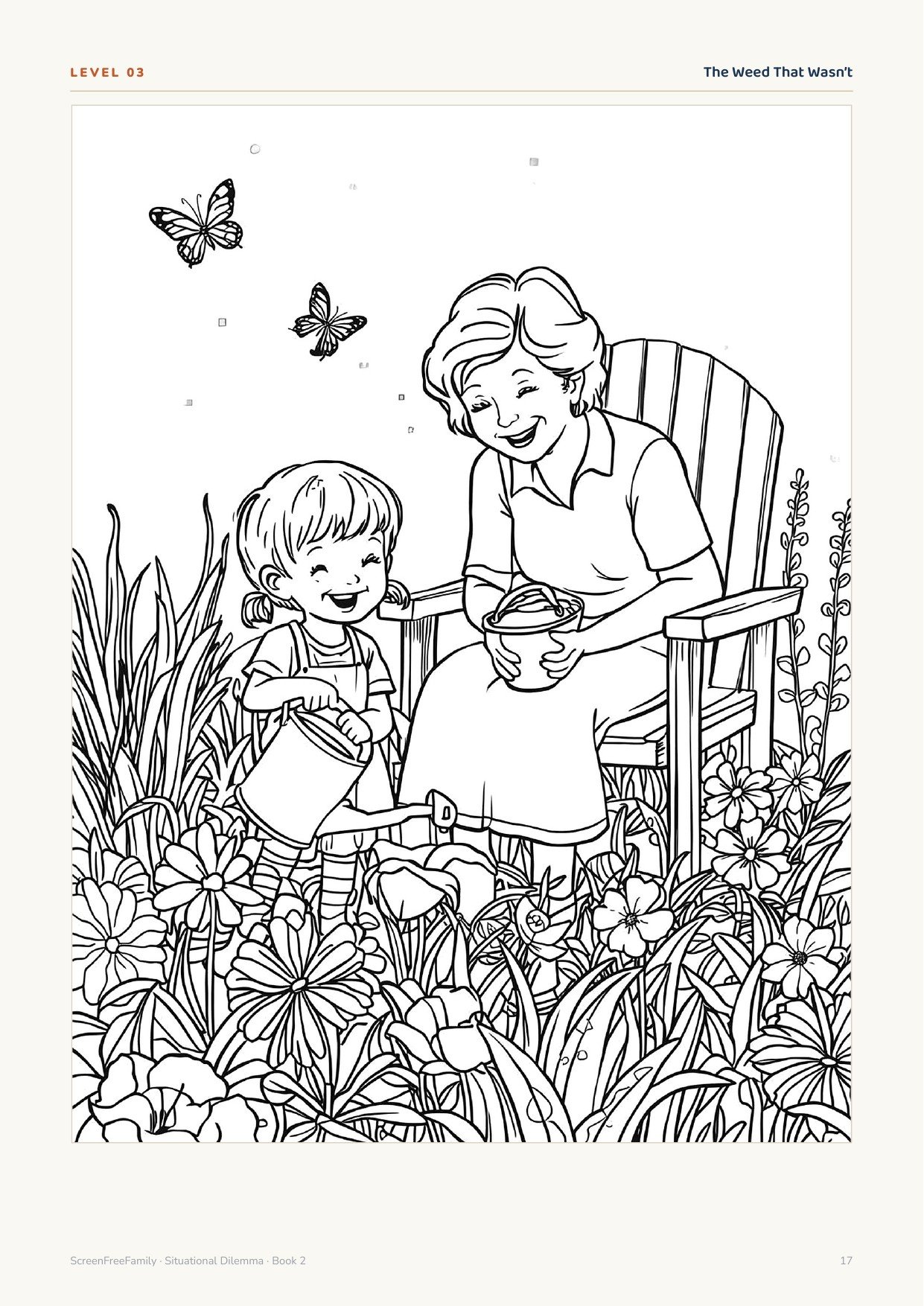
- 20 full-page colouring illustrations, one for each situation
- 20 dilemmas with 60 A/B/C choices
- 40 thinking questions and 20 activities — puzzles, planning, role-play, mapping, making things and asking a grown-up
- The Four Corners thinking tool, plus a new Whose-Is-It Check for this book
- After-It-Happened Words — a page of words for thinking with
- What Really Happens — 60 delayed outcomes, kept at the back
- Thinking Points, a Final Scorecard, the Style Finder and a Situational Style Profile
- A free Starter Badge plus four badges earned at Levels 5, 10, 15 and 20
- The Lost Button Hunt — one button hidden on every situation page
- Reflection, Pass It On, Activity Answers and a Certificate of Choice Champion
How each situation works
- Colour it. A full-page illustration of the family setting. Take as long as you like.
- Read what happened. The same family moment, written down, with the bit that makes it tricky.
- Stand in the Four Corners, then tick A, B or C. The honest choice.
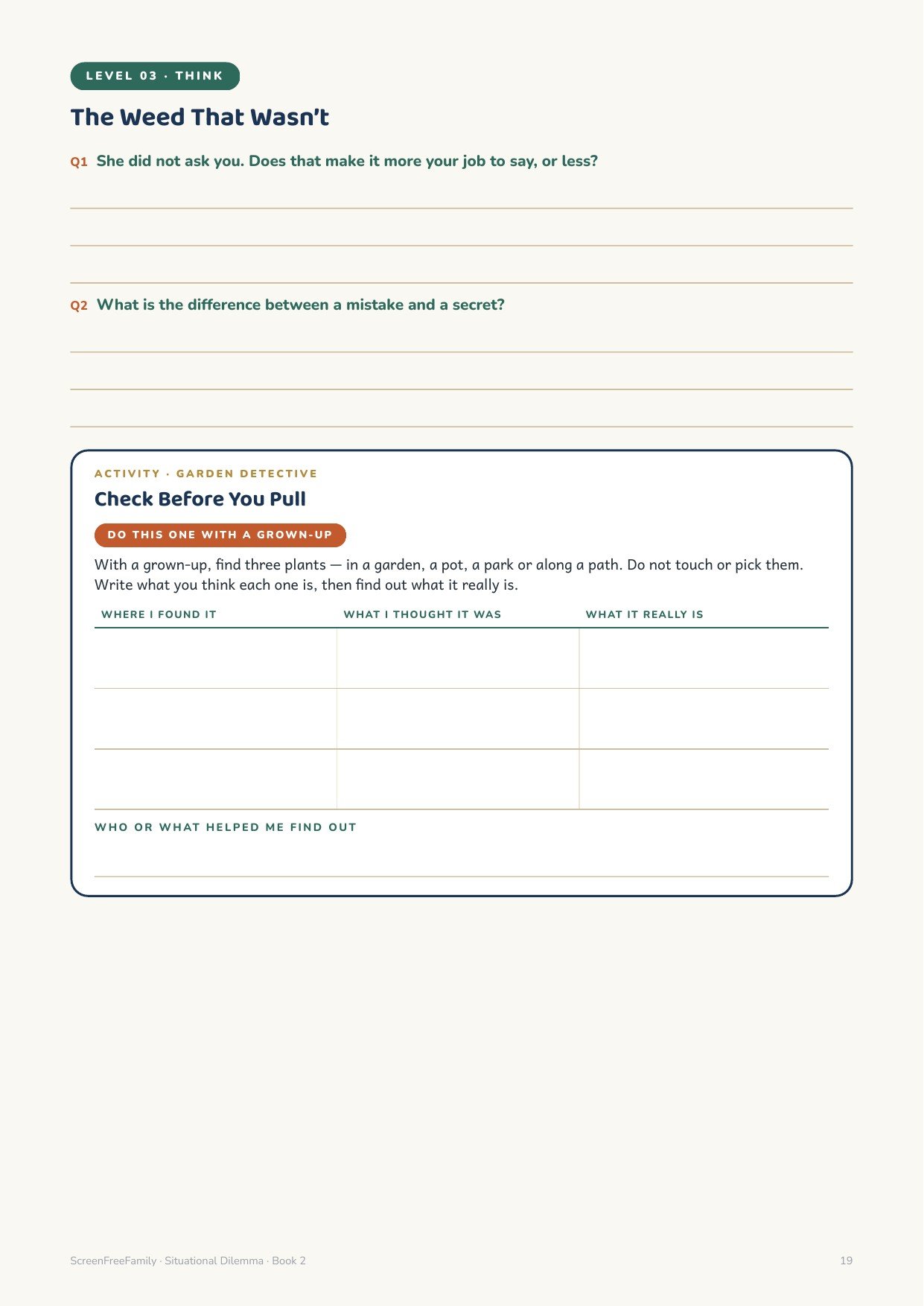
- Think. Two questions about the choice just made. There are no marks for these.
- Do the activity. Some stay on the page. Some send your child off it, into your actual house. Where a grown-up is needed, the page says so.
- Find the button. Somebody in this family keeps losing buttons — there is one on every situation page.
What happened next stays at the back of the book on purpose. If your child reads it first, they are not deciding any more — they are copying. After all twenty, they turn to the back, discover what each choice led to, count their Thinking Points, find their style and fill in their certificate.
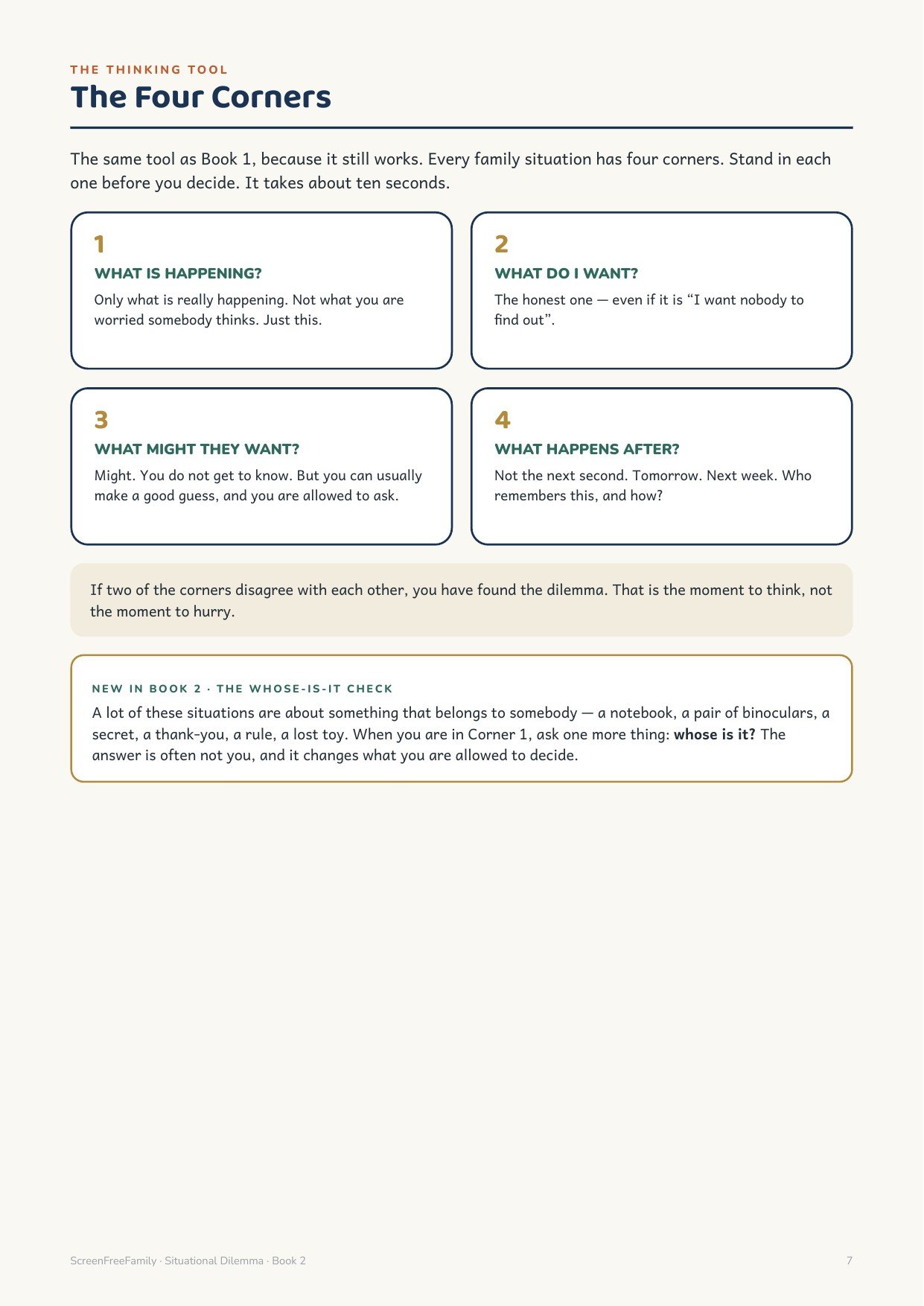
The Four Corners
Before every choice, your child stands in four corners, one at a time:
- What is happening? Only what is really happening.
- What do I want? The honest answer — even if it is “I want nobody to find out”.
- What might they want? You do not get to know, but you can make a good guess, and you are allowed to ask.
- What happens after? Not the next second. Tomorrow. Next week.
When two corners disagree, you have found the dilemma. New in Book 2 is the Whose-Is-It Check: many of these situations involve something that belongs to somebody — a notebook, a pair of binoculars, a thank-you, a rule, a lost toy — and asking “whose is it?” changes what a child is allowed to decide.
The twenty situations
Grandad Says Yes · All By Yourself · The Weed That Wasn’t · Not For Reading · Race to the Flag · What’s That Tune? · Swapsies · The Cat Chose Me · Who Did This? · It’s Fine, Really · Don’t Tell Me — Actually, Tell Me · Somebody Dropped This · I Saw Where You Went · Elephants Are Grey · Come Up to the Front · Not Mine to Borrow · Our Game · Nobody Would Know · Nobody Else Dressed Up · The One That Got Away
Between them they cover owning up to a mistake, credit that went to the wrong person, privacy, surprises, deals and swaps, borrowed things, lost property, giving somebody space, shared blame, saying sorry and putting it right, spoilers, fair play, advice you did not ask for, queues, joining in, house rules when nobody is checking, embarrassment, and promises that got harder to keep.
Six situations with two good answers
Real life does not always have one best move. In six of the twenty situations, two answers work equally well — and the page says so before your child chooses. They pick the one that fits them, then see at the back whether they agree.
Thinking Points, the Style Finder and the certificate
Each outcome earns 3, 2 or 1 Thinking Points for how well that choice deals with what happened. Nobody scores zero, no choice is called wrong, and the book states plainly that points are not for being nice or for being good — a kind-sounding answer can score 1 and a blunt-sounding one can score 3.
The Style Finder then shows which of five styles your child reached for most after something happened — the Open Book, the Keeper, the Fixer, the Giver or the Right-Nower. These are five new styles, different from Book 1. The book says it itself: the longest bar is not the best one or the worst one; it is a habit. It is a game, not a test of what kind of person your child is.
Along the way there is a free Starter Badge, four badges to earn (Line Finder, Cool Head, Fair Player and Choice Champion), a Reflection page, and Pass It On — where your child writes a family situation of their own, with three honest choices, and a grown-up has to tick.
A standalone book — no Book 1 required
The book says it on its first pages: Book 1 is not needed — you can start here. Families who already have Book 1 will recognise the Four Corners and the A/B/C format, and will find twenty new situations, a different kind of dilemma, new activities and a new set of styles.
Why children may enjoy it
Every level starts with colouring. The situations are about things children actually meet — a sour jam sandwich after a swap, an astronaut costume at a party where nobody else dressed up, a cat that picks the one person who is scared of cats. The activities keep changing, the buttons are hidden, and the answers are locked away at the back until the very end.
Why parents may value it
It gives a family something real to talk about without anybody being in trouble. The situations are ordinary, the choices are all believable, and the book openly invites families to disagree with its outcomes and say why. The grown-ups’ page is clear on one more thing: do not use these situations to settle a real argument at home.
Who it’s for
Children aged about 6–9, working on their own or alongside a grown-up. There is no time limit and no set order — one situation an evening or four on a wet Sunday, as long as the outcomes stay unread until the end. Activities that go outdoors or involve plants ask for a grown-up by name.
Digital format
- Digital PDF — nothing is physically shipped
- 91 pages, A4
- Print at home, or read on a tablet or computer
- You will need a pencil, and colouring pencils or crayons for the illustrations
- Instant digital delivery after successful payment
- Download link is also provided by email
Printing for your family
The book is sold under a Personal Use Licence. You may print, and re-print, as many copies as the children in your own household need — colour it in, write in it, cut out the certificate, and print a fresh page when one gets ruined.
Personalised copy
Every purchased copy is individually personalised. The generated PDF includes a personalised footer on applicable interior pages containing:
Personal Copy · [BUYER NAME] · [PERSONAL COPY ID]
The Personal Copy ID is unique to that customer’s copy. The personalisation does not change the book’s content, page count or dimensions.
The PDF is licensed for personal, non-commercial use within the purchasing household only. Please do not share the PDF outside your household, upload it to a website, cloud drive, messaging group or school portal, or use any page in a paid class, club or worksheet pack.
Frequently asked questions
What age is it for?
Children aged roughly 6–9.
Does my child need Book 1 first?
No. Book 1 is not needed — Book 2 works completely on its own.
How is Book 2 different from Book 1?
Book 1 is about what to do while a tricky moment is happening. Book 2 is mostly about the moment after something has already happened. It has twenty new situations, new activities, a Whose-Is-It Check, and five new styles.
How many situations and choices are there?
20 situations, each with three choices — 60 choices and 60 outcomes.
Is there always one correct answer?
No. Six situations have two answers that work equally well, and the page says so before your child chooses. No choice is called wrong.
Is this a test?
No. It is not a test of whether a child is good, and it is not a psychological assessment or personality test. Your child is asked to tick what they would really do.
What are Thinking Points?
Each outcome earns 3, 2 or 1 points for how well that choice deals with what happened. They follow the book’s own framework, explained on a page of their own. Totals run from 30 to 60, and nobody scores zero on any level.
Can we disagree with the book?
Yes — the book asks you to. The outcomes are one considered reading of each situation, and the scorecard has a place to note a score you see differently.
Can I print it, and can siblings use it?
Yes. You may print as many copies as the children in your own household need.
Can my child use it independently?
Yes, most of it. Some activities are marked “do this one with a grown-up”, and Pass It On needs a grown-up to tick.
What happens after all twenty situations?
Your child turns to the back, reads what each choice led to, adds up their Thinking Points, finds their style, fills in their Situational Style Profile and Reflection, writes a situation of their own for a grown-up in Pass It On, and completes their certificate.
A note for grown-ups
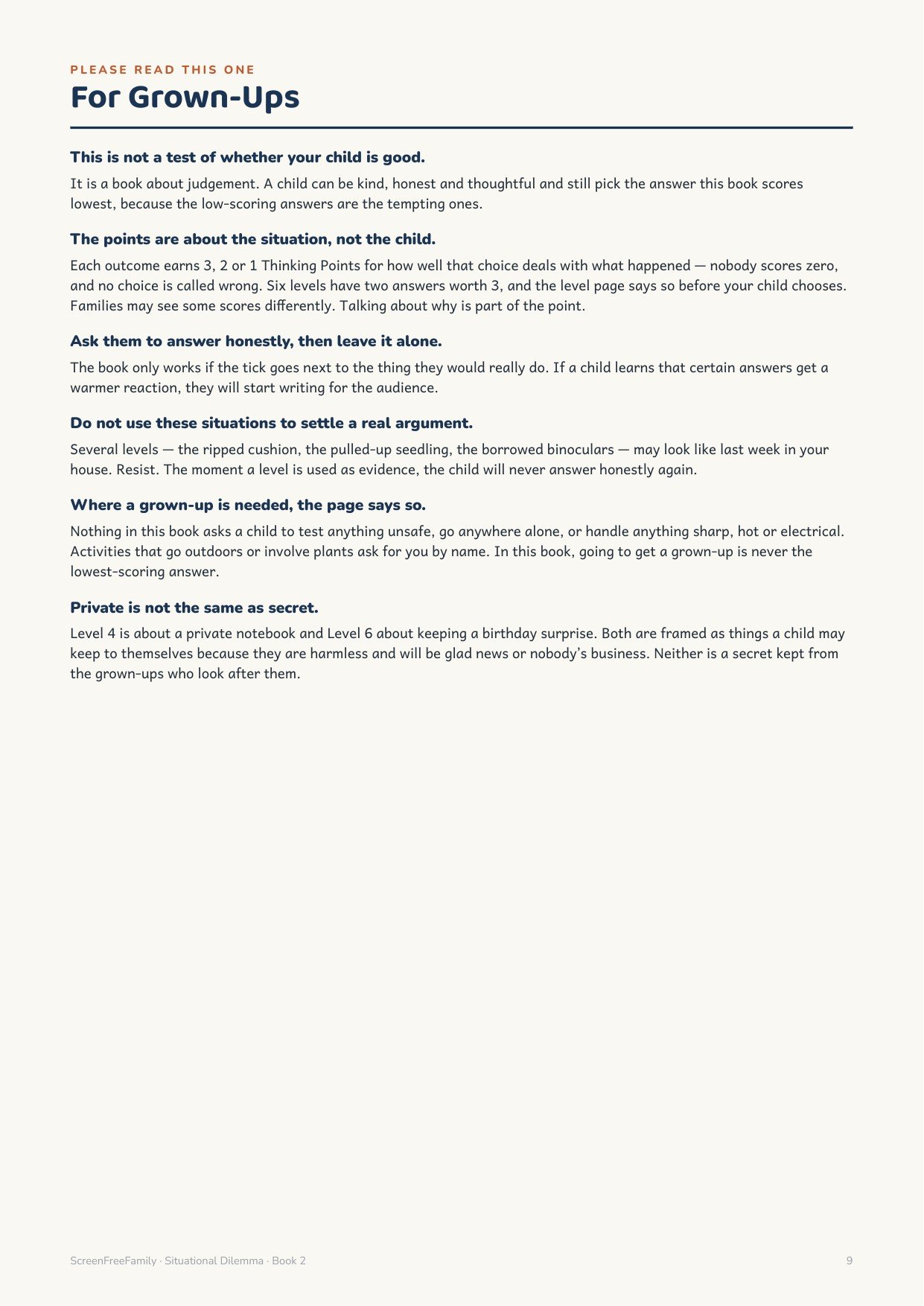
This is not a test of whether your child is good. It is a book about judgement, and a kind, thoughtful child can still choose an answer the book scores lower — because the lower-scoring answers are the tempting ones.
Thinking Points follow the book’s own thinking framework and are explained on a page of their own. Six levels have two answers that both score full points. Families may see some situations differently from the book, and talking about why is part of the point.
Situational Dilemma · Book 2 is an entertainment and learning product for children aged roughly six to nine. It is not a psychological assessment, a personality test, a behaviour programme, or professional advice of any kind.
Additional information
| Age | |
|---|---|
| Format | |
| Activity Type | |
| Moment | |
| Setting | |
| Players |